Comment on 'What have economists learned about monetary policy over the past 50 years?' by Lars Svensson
Comment by Athanasios Orphanides, Governor of the Central Bank of Cyprus, at the conference marking the 50th anniversary of the Bundesbank
Frankfurt, 21 September 2007
It is an honour to participate in this celebration marking the 50th anniversary of the Deutsche Bundesbank. So much of what we have learned about good monetary policy is embodied in the actual historical monetary policy of this great institution. As a European, and on behalf of all European citizens, I believe that we owe a debt of gratitude to the Bundesbank for providing the foundation for the policy we are now continuing with the European Central Bank for the benefit of Europe as a whole.
Our topic is what monetary economists have learned about policy in the past 50 years, but in my view we need to study not only what economists learn but also what economists may forget and perhaps rediscover over time. In my reading of history of the past 50 years, I find that we have learned some new lessons. But many of the things that appear to be new lessons are actually old lessons that have been rediscovered.
The most important lesson learned concerns the design of institutions for monetary policy. The key for institutional design has been the recognition of price stability as the primary operational objective of monetary policy, achieved by providing a legislative mandate for price stability to the central bank and by endowing the central bank with the independence necessary to pursue its primary objective. The most important lesson rediscovered---and I hope we don’t keep forgetting and rediscovering it---is how essential it is to acknowledge the limits of our macroeconomic knowledge and the virtue of being modest in the objectives we set for monetary policy.
Monetary economists have been arguing about the virtues of price stability for centuries but it has only been during the last 50 years that politicians in many nations have taken the necessary steps to ensure that price stability would be the primary operational objective of monetary policy. In Europe, this has been enshrined in the Maastricht Treaty. The mandate for the European System of Central Banks states (Article 105(1)): "The primary objective of the ESCB shall be to maintain price stability". Full stop! It is important to keep this in mind. Of course, subject to that, the central bank should also do whatever else it can do to enhance the welfare of European citizens. This is why the Treaty continues: "Without prejudice to the objective of price stability the ESCB shall support the general economic policies in the Community". But the crucial element is the recognition of the primary nature of price stability as the central bank’s objective.
Not all legislative mandates around the world are similarly formulated. For example, in the United States the Federal Reserve has a so called "dual mandate", listing maximum employment and growth as a goal along with price stability. However, over the past quarter of a century this mandate has been interpreted in a manner that also recognises the primacy of price stability (Orphanides, 2006). In my view, the success of monetary policy in the United States over the past quarter of a century can be largely attributed to this proper interpretation of how monetary policy can best contribute to economic welfare. Describing the monetary policy strategy of the Federal Reserve, for example, Alan Greenspan referred to: "our goals of price stability and the maximum sustainable economic growth that we associate with it" (my italics),(Greenspan, 2004), thus recognising the primacy of price stability and its importance for achieving maximum sustainable growth.
Unless it is clearly stated, however, there is a risk that the primacy of price stability as an operational objective may at times be incorrectly interpreted. Thus, to avert the risk of misinterpretation and the ensuing policy errors, it is preferable to strive for clarity in the mandate which would ensure full political support.
The benefits of price stability are certainly far-reaching. That said, price stability should be the primary objective of monetary policy not because it is the ultimate welfare objective but because it is a necessary precondition for fostering economic prosperity. In essence, it is better to view price stability as a very convenient intermediate target - an operational objective for a central bank - a guide whose achievement is sought in order to facilitate a nation to grow and prosper over time. I make this distinction because, while I believe that we can all agree that the historical evidence supporting the importance of price stability is overwhelming, theoretical work in macroeconomics does not always lead to this conclusion without additional assumptions. And the validity of such assumptions may be hard to confirm on the basis of available evidence. For example, existing microeconomic foundations for the primacy of price stability in aggregate macroeconomic models are not thoroughly convincing. As a result, much of the literature on policy evaluation posits that price stability is one of the ultimate policy objectives to avoid implausible policy conclusions. However, the fact that we may not yet have satisfactory microfoundations for the analysis should not confuse the situation. The historical experience is too overwhelming to ignore the pitfalls of formulating policy without price stability as the dominant operational policy guide.
Perhaps the most important advantage stemming from clarity regarding the primacy of the price stability objective is that such clarity promotes credibility and facilitates the anchoring of inflation expectations. This benefit becomes crucial in the presence of adverse shocks such as supply disturbances which may result in temporary increases in inflation and shortfalls in production. Maintaining well-anchored inflation expectations provides flexibility to respond to temporary economic disturbances that might otherwise wreak havoc on the real economy, and can thus help the central bank maintain overall stability. Credibility also provides flexibility for swift responses to financial disturbances. For example, injecting liquidity into the economy during periods of financial turmoil is an option that a credible central bank can consider without risking an adverse response in inflation expectations. That is, when the central bank’s primary focus is price stability, the public may be assured that the central bank will not lose sight of its objective. As a result, expectations need not be adversely influenced by policy actions taken in response to financial disturbances that might otherwise be interpreted as potentially inflationary. Thus, policy becomes more effective overall.
Regarding operational policy design, I would argue that the most important lesson learned over the past 50 years is something that was known in the past but was forgotten - and may still be, perhaps, insufficiently appreciated by monetary theorists. This is acknowledging the limits of our knowledge and its implications, which I discuss below.
I believe that we all recognise the importance of policy guided by systematic policy rules rather than by policymaker’s discretion. But what does this mean in practice? In my view, we need a disciplined focus on simple operational policy guidelines that could be implemented in practice. These guidelines should not be mechanistic, such as simple formulas responding to recent outcomes in the economy. In light of the transmission lags in monetary policy, policy actions must be, to a large extent, pre-emptive and be formulated on the basis of forecasts. The key is the identification and evaluation of the risks to price stability in the outlook. Thus, inflation forecasting is a necessary component of the policy process and successful simple rules ought to take into account the risks that inflation might deviate from a policymaker’s price stability objective in the short and medium term.
Still, successful policy does not require a complex policy framework and complicated model-based inference and calculus. Indeed, better outcomes are likely with simple robust frameworks (Orphanides and Williams, 2007). The monetary policy framework of the Deutsche Bundesbank, with its focus on guidance from monetary aggregates for assessing risks to price stability, serves as an excellent example. It succeeded in delivering price stability where many other more complex approaches failed. The inflation targeting framework, as implemented by the Reserve Bank of New Zealand during the 1990s, serves as another example. In the case of inflation targeting, the inflation forecasts served as direct guides to policy and the policy framework could be easily described just in terms of these forecasts. Thus, policy decisions to ease or tighten could be deduced by examining deviations of the inflation forecast from the central bank’s target. The rule could be simply stated as adjusting monetary conditions so as to achieve gradual convergence of the forecast to the target.
But why focus on simple operational policy rules? Why not opt for more complex policies that might allow policymakers to fine-tune the performance of the economy, as can be derived by modelling exercises and applying well-known optimisation techniques such as optimal control(1)? The answer is the crucial lesson rediscovered at least twice over the past century in monetary economics - that in designing policy we ought to respect the limits of our knowledge.
The economic theorist can be easily lured by the beauty of the latest "state-of-the-art" model of the macroeconomy. Armed with such a model, the economic theorist may succumb to the temptation to assume that this model is correctly specified, abstracting from potential errors, and proclaim that policy should be identified as the solution to a mechanical optimisation problem based on the model. Such policy prescriptions, the theorist may then claim, must be superior to simple guides, provided the model is assumed to be correct. The trouble is that in the history of macroeconomics we can identify numerous "new eras" that have come and gone when theorists proclaimed to have figured out the correct model of the economy and the implied enhanced ability of policy to do more than merely stabilise the price level. The pattern, usually, is to identify real targets for the economy that in theory are compatible with price stability and then suggest that policy should be guided by these targets, in addition to price stability.
The experience of the Federal Reserve following the 1920s and the 1960s presents useful examples of the pitfalls of failing to respect the limits of macroeconomic knowledge. These are episodes when policy was arguably influenced by theory in a rather detrimental manner. On both occasions, policymakers were urged to improve on their strategy of focusing on achieving and maintaining price stability by attempting to fine-tune economic activity as a means of fighting and perhaps eliminating business cycles. Milton Friedman used the first of these episodes to introduce his seminal presidential address delivered in 1967. As he pointed out, the concept of fine-tuning (though not the name) was first introduced by Federal Reserve economists during the 1920s, when for the first time monetary economists thought that their knowledge of the monetary transmission mechanism was sufficient to allow them to engage in fine tuning:
"In the first flush of enthusiasm about the newly created Federal Reserve System, many observers attributed the relative stability of the 1920s to the System’s capacity for fine tuning - to apply an apt modern term. It came to be widely believed that a new era had arrived in which business cycles had been rendered obsolete in monetary technology. … The Great Contraction destroyed this naive attitude" (Friedman, 1968, p. 1).
Undoubtedly, Friedman talked about this first experience with "fine-tuning" in the United States because he was concerned that the lessons had been forgotten and could detect signs that a similar mistake was about to be repeated. His concerns proved to be justified.
Following Friedman, it may be instructive to use "apt modern terms" to describe the policy mistakes following the 1960s episode of overconfidence in proclaiming a new era when business cycles could all but be eliminated. I will look at a specific policy decision couched in terms of modern theory in order to highlight what I believe is a rather risky interpretation of how central banks should implement the so called "flexible inflation-targeting" framework.
To set up the historical example, I note that conventional theoretical models of the policy problem are typically formulated in terms of gaps from "equilibrium" or "natural rate" concepts, often denoted with stars. For example, we have
-
the natural rate of interest, r*
-
the natural rate of unemployment, u*
-
the level of potential output, q*
A key issue is how these stars (the starred variables) should be used for policy design if they are not reliably measured. A theorist can formulate a model and say that the economy may be described as underperforming or being overheated in terms of the output gap, introducing one of the stars - potential output - or equivalently, the related star referring to the unemployment rate. The real side of the economy can be linked to inflation by associating a positive output gap with increasing inflation and a negative gap with decreasing inflation. Thus, knowledge of a real economic activity star can lead to a gap-based policy that in theory can be quite useful in controlling inflation. Furthermore, policy can be described as accommodative or restrictive in terms of the real interest rate gap, based on the interest rate star.
By definition, in this framework knowledge of the stars can be very useful for forecasting. The real interest rate gap should help forecast the output gap and the output gap should in turn help forecast inflation. Thus, assuming sufficient knowledge, the theorist can suggest that this framework could be applied and be used for policy design. Indeed, under some assumptions we can design situations where the mechanical optimisation solution corresponds to optimal control answers arising out of this. An example is to choose the policy rate (and its path over time) so that the projected path of the real interest rate gap, (rt – r*), is such that forecasts of the inflation gap, (π - π*) are roughly proportional to forecasts of the output gap, (q – q*). This may be proclaimed to be good policy advice.
A significant problem, however, is that if the stars and their evolution over time are unknown, policy advice from this framework can be very problematic. Indeed, this was emphasised by Milton Friedman in his presidential address:
"One problem is that [the policymaker] cannot know what the ‘natural’ rate is. Unfortunately, we have as yet devised no method to estimate accurately and readily the natural rate of either interest or unemployment. And the ‘natural’ rate will itself change from time to time" (Friedman, 1968, p. 10).
Needless to say, and as anyone who has delved into empirical exercises attempting to measure the stars can attest, we have made no discernible progress since Friedman’s presidential address in measuring the stars with greater accuracy in real time.
To return to the historical example, I wish to explore how the beginning of the fine-tuning mistake committed by the Federal Reserve at the turn of the 1970s could be described in terms of the interpretation of "flexible inflation targeting" I noted earlier. I focus on the policy decision at the August 1970 FOMC meeting and consider what policy decision Federal Reserve policymakers should have arrived at if they had attempted to follow modern calls for setting policy on the basis of forecasts of the output gap and inflation gap, gradually closing both as generally implied by the optimal control exercises that form the basis for the interpretation of "flexible inflation targeting" that I consider risky. Would such procedures have resulted in good economic outcomes?
Figure 1 presents the data and forecasts regarding inflation and the output gap as available to the FOMC at the time of the August 1970 meeting. For visual convenience, the figure aligns the path of inflation (and its deviation from an assumed 2% inflation target) and the path of the output gap. Note that with actual and projected inflation remaining above the assumed target, a policymaker following the simple guide of an inflation targeter would have tightened policy so as to bring inflation back towards target. Needless to say, had this simple inflation targeting rule been followed consistently during that time, we would not have experienced the Great Inflation of the 1970s in the United States. But flexible inflation targeting, with sufficient flexibility to be guided by the forecast of the output gap, would have suggested a very different answer. The flexible inflation targeting policymaker would have noticed that the output gap was extremely negative and not projected to improve in the forecast horizon. Thus, in order to maintain the appropriate degree of proportionality and close both the inflation and output gaps together, policy would have to be eased. Judging from the output gap forecast, there was a lot of room for easing policy. Indeed, that should have been the optimal policy in such a framework.
Interestingly, the analysis of the Federal Reserve staff, as quoted in the FOMC Memorandum of Discussion, was in line with this interpretation of "flexible inflation targeting".
"Moreover, the upturn would be starting from a point where there is substantial underutilization of resources, as evidenced by a 5 percent unemployment rate and an operating rate in manufacturing at well under 80 percent of capacity. In these circumstances, there is virtually no risk that economic recovery over the year ahead would add to the inflationary problem through the stimulation of excess – or even robust – demand in product or labor markets" (Federal Reserve Board, FOMC, Memorandum of Discussion, August 1970, p. 19).
Looking at the output gap, and in line with the flexible inflation targeting framework, the decision was obvious. Policy was eased and, in theory, this should have resulted in a gradual reduction in inflation, as reflected in the forecast, and gradual diminution of the inflationary problem. Unfortunately, history did not confirm this scenario. Instead of the anticipated gradual return to price stability, the 1970s turned into the Great Inflation.
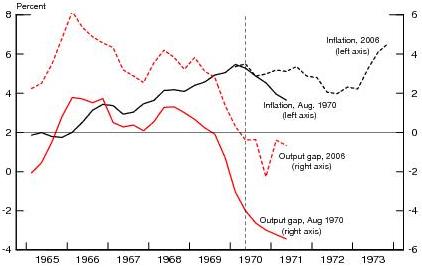
The reason for the mistake can be deduced from Figure 2. The assumed confidence about knowledge of the stars was misplaced. The stars were not known then, indeed they can never be known with much confidence, and thus should not be heavily relied upon for policy guidance. Superimposing a recent estimate of the output gap (from the Congressional Budget Office) on the earlier figure shows the extent of the mismeasurement. If this additional information could have been known, it is clear that even the flexible inflation-targeting policymaker would have followed the policy of the inflation targeter and would have tightened policy in that episode. In short, while the simple inflation-targeting framework would have avoided the error, a flexible inflation-targeting framework would not.
The mistake in the historical example highlighted in Figures 1 and 2 was not isolated. Unfortunately, the quest for pursuing what in theory seemed "optimal" infected policy decisions for quite sometime during the early 1970s at the Federal Reserve. As Herbert Stein, then a member of the Council of Economic Advisers in the United States, later described:
"It would be the goal of monetary policy to keep the economy on the OFP [optimum feasible path], and while that goal would not be contstantly achieved, the OFP would be the most probable path of the economy because monetary policy would be seeking to achieve it". (Stein, 1984)
Which brings me to the most recognisable and important lesson for practical policy design, as identified decades ago by Milton Friedman in his presidential address:
"The first and most important lesson that history teaches about what monetary policy can do – and it is a lesson of the most profound importance – is that monetary policy can prevent money itself from being a major source of macroeconomic disturbance" (Friedman, 1968, p. 12).
In summary, one might ask: How can this be achieved? The answer is simple and can be found by looking at the experience of the Deutche Bundesbank and the framework put in place for the ECB. One should start with the correct institutional framework, one that respects what we have learned to be important from history. The first crucial element is central bank independence. The second is the primacy of price stability. And, finally, for operational purposes the emphasis on keeping inflation expectations well anchored and a medium-term orientation with the focus on policy robustness, as opposed to fine-tuning alternatives.
-------------------------------------------------------------
ENDNOTES:
(1) The term "flexible inflation targeting" is also used by some authors to describe this optimal control approach to policy, in contrast to the simple "inflation targeting" framework.
REFERENCES:
Federal Reserve Board (1970) FOMC Memorandum of Discussion, August.
Friedman, Milton (1968) "The role of monetary policy: presidential address", American Economic Review, 58(1): 1-17.
Greenspan, Alan (2004) "Risk and uncertainty in monetary policy", American Economic Review (Papers and Proceedings), 94(2): 33-40.
Orphanides, Athanasios (2006) "The road to price stability", American Economic Review (Papers and Proceedings), 96(2): 178-181.
Orphanides, Athanasios and John C. Williams (2007) "Inflation targeting under imperfect knowledge", in F. S. Mishkin and K. Schmidt-Hebbel (eds) Monetary Policy Under Inflation Targeting, Santiago: Central Bank of Chile.
Stein, Herbert (1984) Presidential Economics: The Making of Economic Policy From Roosevelt to Reagan and Beyond, New York: Simon & Schuster.
FIGURE 1: Inflation and Output Gap Forecasts for the US Economy as seen in August 1970
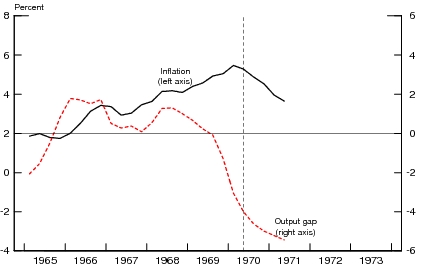
FIGURE 2: Inflation and Output Gap Forecasts and Retrospective Outcomes